Friday, September 16, 2011

Larcher


JOE:  General Larcher is one of the handful of characters created solely for the graphic novel. I also took the most liberties with him. He is a formidable enemy for Stryke and his war band and tries to match their ferocity on the battlefield. Despite his musclebound physique, he is terribly insecure and if there were performance enhancing drugs in his time and place, he would most certainly use them and then deny it up and down. He almost has a sliver of respect andawe for the orcs he's be charged with obliterating.


STAN:  All stories, no matter how epic, are best told through focusing on the trials and tribulations, the setbacks and triumphs of individuals embroiled in the greater plot.  (Think Shakespeare, War and Peace, The Lord of the Rings . )  You risk losing reader empathy unless you zero in on your main protagonists and tell your tale through them.  Which means that to some extent your characters stand not only for themselves but also their race, their culture and the sweep of history carrying them on.  So apart from being a character in his own right, General Larcher, like Kimball Hobrow, represents something bigger.  In Larcher's case it's the cause he supports, and to some degree a certain type of military mind - the inflexible sort.  But he isn't without his doubts.  The certainty of his faith and the rigidity of his soldierly thinking are somewhat at odds with the grudging respect he feels for his opponents, the orcs.  He's a bit conflicted.    

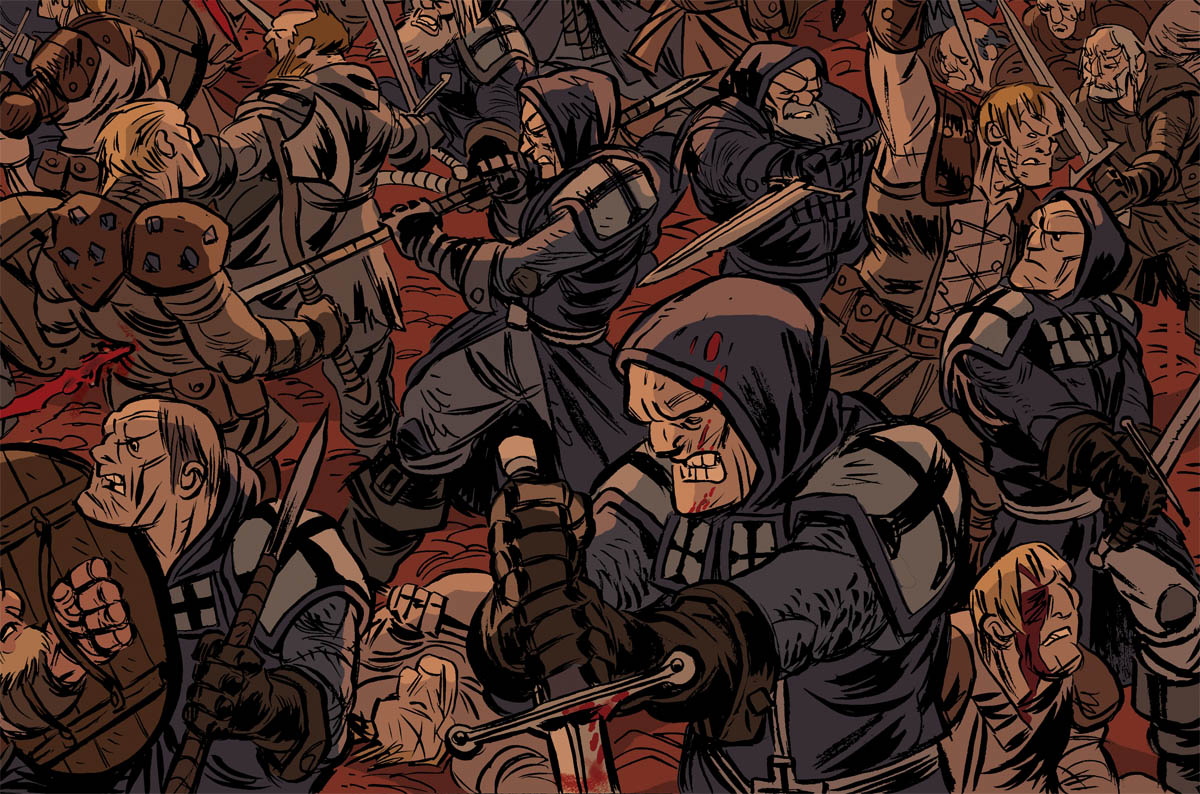
JOE:  While developing Larcher, I continued to play around with the Uni uniform. I looked at Nazi officer's uniforms to add little touches to the Uni's garb. The Uni collar and belts and boots are all inspired by some of histories greatest monsters.


Wednesday, September 14, 2011

Followers


JOE: When it came to the Uni Soldiers who fight for Kimbal Hobrow's fanatical religious cause I automatically thought of the European Crusaders in the Holy Land in the 11th and 12th centuries.


STAN: This is an interesting example of Joe adding something - or, rather, expanding on something - that I didn't go into too much detail about in the novels.  I simply implied that the Unis wore some kind of uniform, but beyond saying they favored black I didn't give specifics.  Joe's beefed that up, and given their appearance an appropriate uniformity.  (Pun unintended!)


Demagogue


JOE: I'm changing things up a bit, I've got a lot more drawings of Stan's misunderstood protagonists, but for the next few posts I'm going to focus on some of the antagonists.


JOE: Kimball Hobrow is described as tall and gaunt, clad in all black with a stovepipe hat. My first thought was, "evil Abe Lincoln?" My thoughts soon turned to the overzealous Puritans from books I read in High School, The Crucible and The Scarlet Letter. I can't help but to compare one piece of literature to another, and then it hit me. "I'm going to model my Kimball Hobrow after Gregory Peck as Captain Ahab in the film adaptation Moby Dick."  This is how I operate. I look at one person's visual adaptation of a piece of literature and use it in my visual adaptation of a completely different piece of literature. Stealing someone's idea and using it in another context is what makes working in the visual arts so much fun.


STAN:  I knew Joe's depiction of Kimball Hobrow reminded me of someone!  (And on the trivia front, John Huston's 1956 version of Melville's classic had Ray Bradbury as its principal scriptwriter, of course.)  I don't think I had any particular model in mind when I came up with Hobrow, though what goes on in our subconscious should never be discounted.  Somehow, and certainly not consciously, an element of the wild west seemed to creep into certain facets of the orcs series, and no more so than in the character of Hobrow.  It was only after I created him that I saw a kind of Judge Bean aspect in there.  Some people assume that I'm being critical of all religion in the orcs books, or indeed faith itself.  What I in fact had in mind were the extremists; the fanatics who try to impose their unbending beliefs on others.  Kimball Hobrow was my attempt at personifying that.


Tuesday, September 13, 2011

M.I.A.

JOE: I'm very disappointed to say, I seem to have lost a bunch of my Alfray sketches. I know I did a lot more than this, but they just disappeared. It's too bad, he's got a great face, very expressive.


 JOE: I don't know if Stan has any back material about the orc life cycle. At what age do they it maturity and how long they live. All I know is, Alfray is old for an orc, but is still strong as hell. Here he is wielding a claymore with relative ease.

STAN:  Orcs have a life-span roughly equal to humans.  Or at least they would if they didn't have such a perilous existence - death is something they risk daily.  Alfray is the oldest member of the war band.  As such, he's a living link to the past in a world changing rapidly, and not for the better, because of the influx of humans.  He remembers earlier, happier times, before the orcs fell from grace and into something akin to slavery.  So there's a sense in which he's a device for emphasizing those changes.  Given that orcs rely on their strength, stamina and martial agility, those few who survive into later life have a constant anxiety about their powers diminishing.  But that's counter-balanced by their accumulation of experience and wisdom.  In this respect Alfray allows me to explore the dilemma of a warrior
fighting his greatest foe - encroaching old age.


More Coilla

STAN:  Coilla's my favourite character, too.  Or at least she's near the top of the list.  In fact, my female characters - like Shani Vanya in my Nightshade trilogy and Serrah Ardacris in the Quicksilver books (known as the Dreamtime trilogy in the US) are invariably my favorites.  I guess it says something about me that I favor feisty, independent females.  I even have a certain affection for Jennesta, the cruel sorceress who's the principal villain in the orcs novels.  She's also one of the few examples in my fiction of a character based on a real person.  Well, an amalgam of two people actually.  I'll leave you to speculate about some of the women I've known .  
 JOE:  One of the things I like most about Coilla is that not only is she hard as nails but she is also the most empathetic. She's the one band member that can put herself into another's shoes.
JOE:  A favorite sketch of mine. Coilla can even see the beauty in a caged harpy, an ugly, scaly and over-sized carrion bird.
                                          

Monday, September 12, 2011

Ode to Liefeld

JOE: Coilla is one of my favorite characters. But at first she was the bane of my existence. Why? Drawing all of those little knives. Trust me, it was a lot harder than is looks. It took me forever to get a handle on all those knives. 
(Arrrggg, again with the terrible puns, sorry I can'y help myself.)


JOE: Let's flash back to the early nineties, the most famous and in turn the most highly paid comic book artists of his time was at the height of his career, Rob Liefeld, and you'd be hard pressed to find a drawing of his without at least one sword and maybe even a couple knives in it, and let's not forget the pouches, the many many pouches. His characters always had a abundant amount of ammunition. Suffice it to say, his art left an impression on me and I too wanted Coilla to be equipped with as many knives as she needed. I wanted people to look Coilla and say, "Damn! that's a lot of knives!" In the same way comic readers in the nineties were impressed by the size of Cable's gun.  For years now, Mr. Liefeld has been criticized for over-arming his characters, among other complaints. Now whether or not I was successful in steering clear of the same folly I will leave up to you the reader.

STAN:  There's a practical point here.  An orcs warband like the Wolverines is a comparatively small, highly mobile unit that has to be ready to travel, and fight, at short notice.  Flexibility is the key.  Which means they have to carry everything they need with them, and that very much includes the tools of their trade: a variety of weapons.  Modern soldiers tote an equally impressive amount of kit.  So Rob Liefeld was tackling this problem in his own decorative way.  I gave Coilla arm-sheaths to carry her knives in, which struck me as a practical solution, if not exactly cutting edge.  (Sorry.  I have a weakness for puns, too.)  


Thursday, September 8, 2011

Stryke Three

JOE: Here are the three stages to a illustration of Stryke, it is a fine example of thelast thing his enemies see before they bite the big one.


STAN:  This is a great depiction of barely suppressed savagery, which is of course one of the orcs' more alarming traits.  But my orcs aren't one-dimensional berserkers.  They're capable of something akin to compassion, when warranted, and they have their own code of honour, even if it can often amount to summary justice.  Like humans, they are, I hope, rounded characters, subject to the same range of emotions as us.  It's just that an orc's emotion are writ very large.